Iteratively subdivides a spatial extent into a freeTilePlan by running
FUN on each tile and splitting any tile whose value exceeds threshold.
Uses tileApply() internally so each pass can be parallelised via
future::plan().
FUN must return a single numeric scalar per tile — typically a point
count, density, or variance measure. Tiles are split into four equal
quadrants until all tiles are either below threshold or smaller than
min_tile_size.
Usage
quadtreePlan(
  x,
  tiles = NULL,
  FUN = nrow,
  threshold,
  min_tile_size = NULL,
  max_depth = 10L,
  ...
)
Arguments
- x
input data (e.g.
SpatVectoror file path).- tiles
starting
tilePlan. Defines the initial coarse grid.- FUN
function. Applied to each tile; must return a single numeric.
- threshold
numeric. Tiles with
FUN(tile) > thresholdare subdivided.- min_tile_size
numeric. Minimum tile side length (in CRS units). Tiles below this size are kept as leaves regardless of density.
- max_depth
integer (default
10L). Maximum subdivision depth.- ...
additional params passed to
tileApply().
Value
A freeTilePlan with an n_records metadata column containing
the last FUN value for each leaf tile.
See also
Other tile plans:
freeTilePlan,
freeTilePlan-class,
pixelTilePlan-class,
pointTilePlan-class,
spatialTilePlan-class,
tilePlan,
tilePlan-class,
tilework-class
Examples
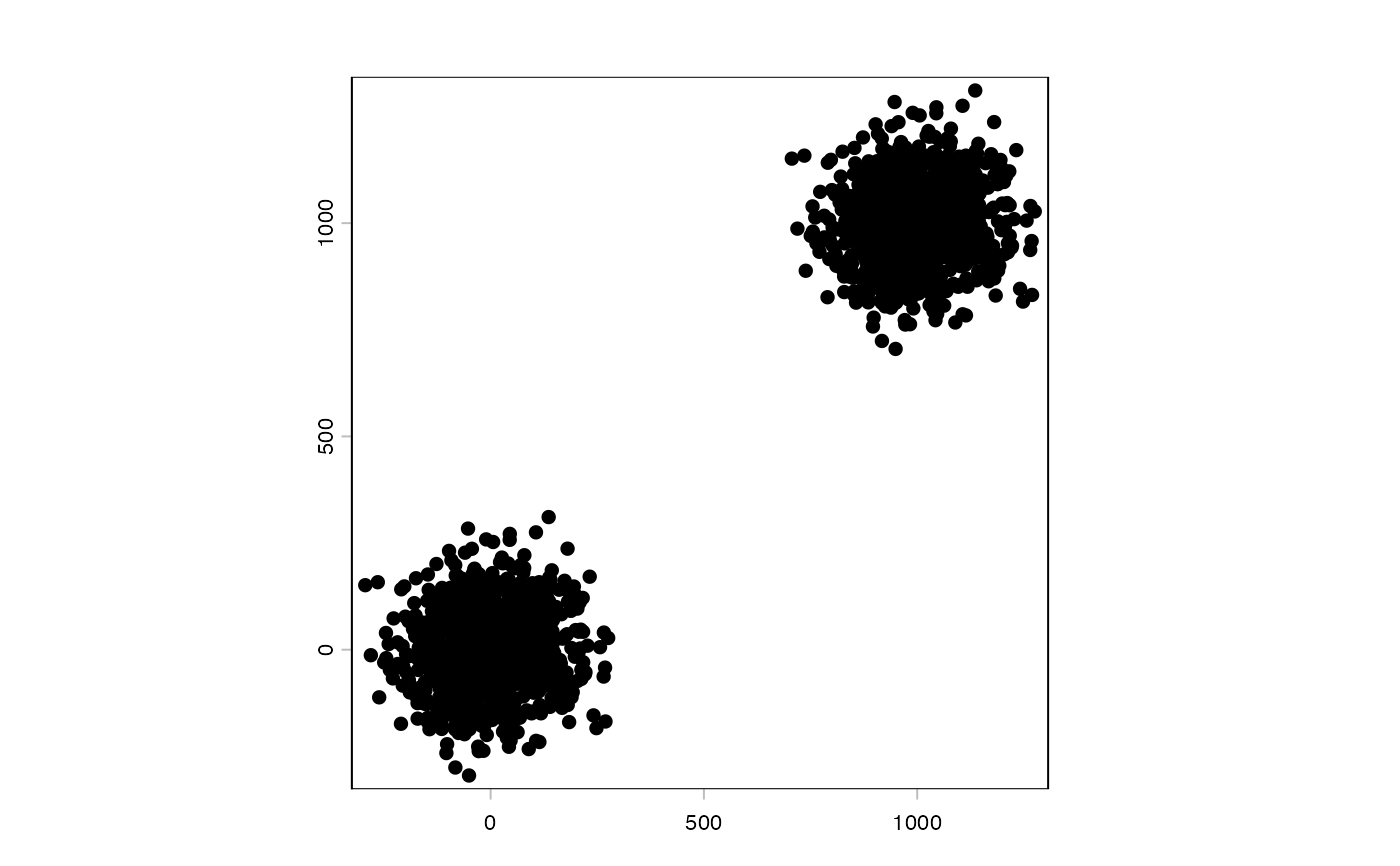
# dummy data
pts <- terra::vect(cbind(x = rnorm(1000, 0, 100), y = rnorm(1000, 0, 100)))
pts <- rbind(pts, terra::shift(pts, dx = 1000, dy = 1000))
plot(pts)
 # data must exist on disk
f <- tempfile(fileext = "shp")
terra::writeVector(pts, f)
pts <- terra::vect(f, proxy = TRUE)
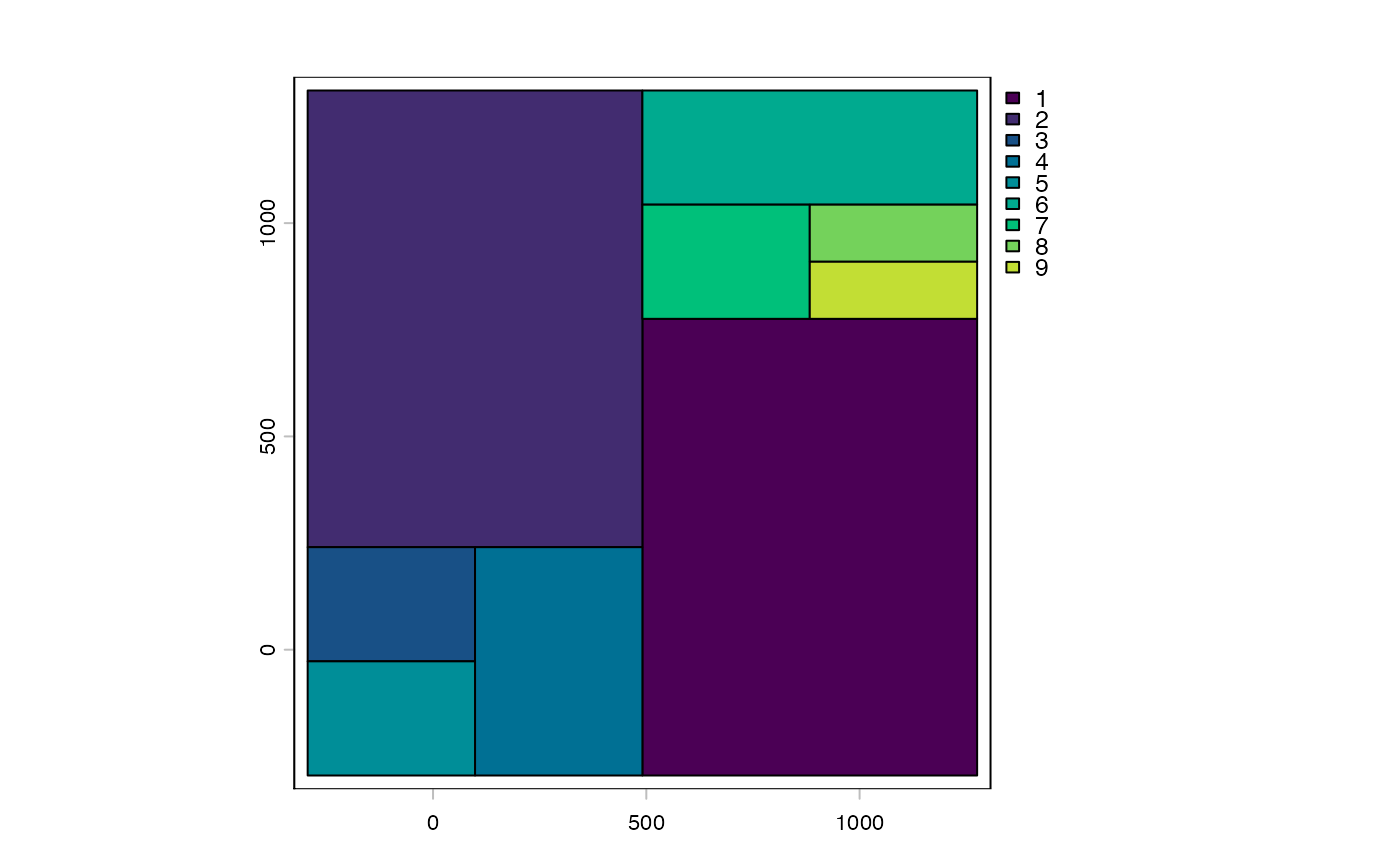
fp <- quadtreePlan(pts,
threshold = 500L,
min_tile_size = 1
)
#> Warning: Your code is running sequentially. For better performance, consider using a
#> parallel plan like:
#> options("tilework.bpparam" = BiocParallel::SnowParam())
#> To silence this warning, set options("tilework.warn_sequential" = FALSE)
#> Warning: Your code is running sequentially. For better performance, consider using a
#> parallel plan like:
#> options("tilework.bpparam" = BiocParallel::SnowParam())
#> To silence this warning, set options("tilework.warn_sequential" = FALSE)
#> Warning: Your code is running sequentially. For better performance, consider using a
#> parallel plan like:
#> options("tilework.bpparam" = BiocParallel::SnowParam())
#> To silence this warning, set options("tilework.warn_sequential" = FALSE)
plot(fp)
# data must exist on disk
f <- tempfile(fileext = "shp")
terra::writeVector(pts, f)
pts <- terra::vect(f, proxy = TRUE)
fp <- quadtreePlan(pts,
threshold = 500L,
min_tile_size = 1
)
#> Warning: Your code is running sequentially. For better performance, consider using a
#> parallel plan like:
#> options("tilework.bpparam" = BiocParallel::SnowParam())
#> To silence this warning, set options("tilework.warn_sequential" = FALSE)
#> Warning: Your code is running sequentially. For better performance, consider using a
#> parallel plan like:
#> options("tilework.bpparam" = BiocParallel::SnowParam())
#> To silence this warning, set options("tilework.warn_sequential" = FALSE)
#> Warning: Your code is running sequentially. For better performance, consider using a
#> parallel plan like:
#> options("tilework.bpparam" = BiocParallel::SnowParam())
#> To silence this warning, set options("tilework.warn_sequential" = FALSE)
plot(fp)
 # plot with items per tile
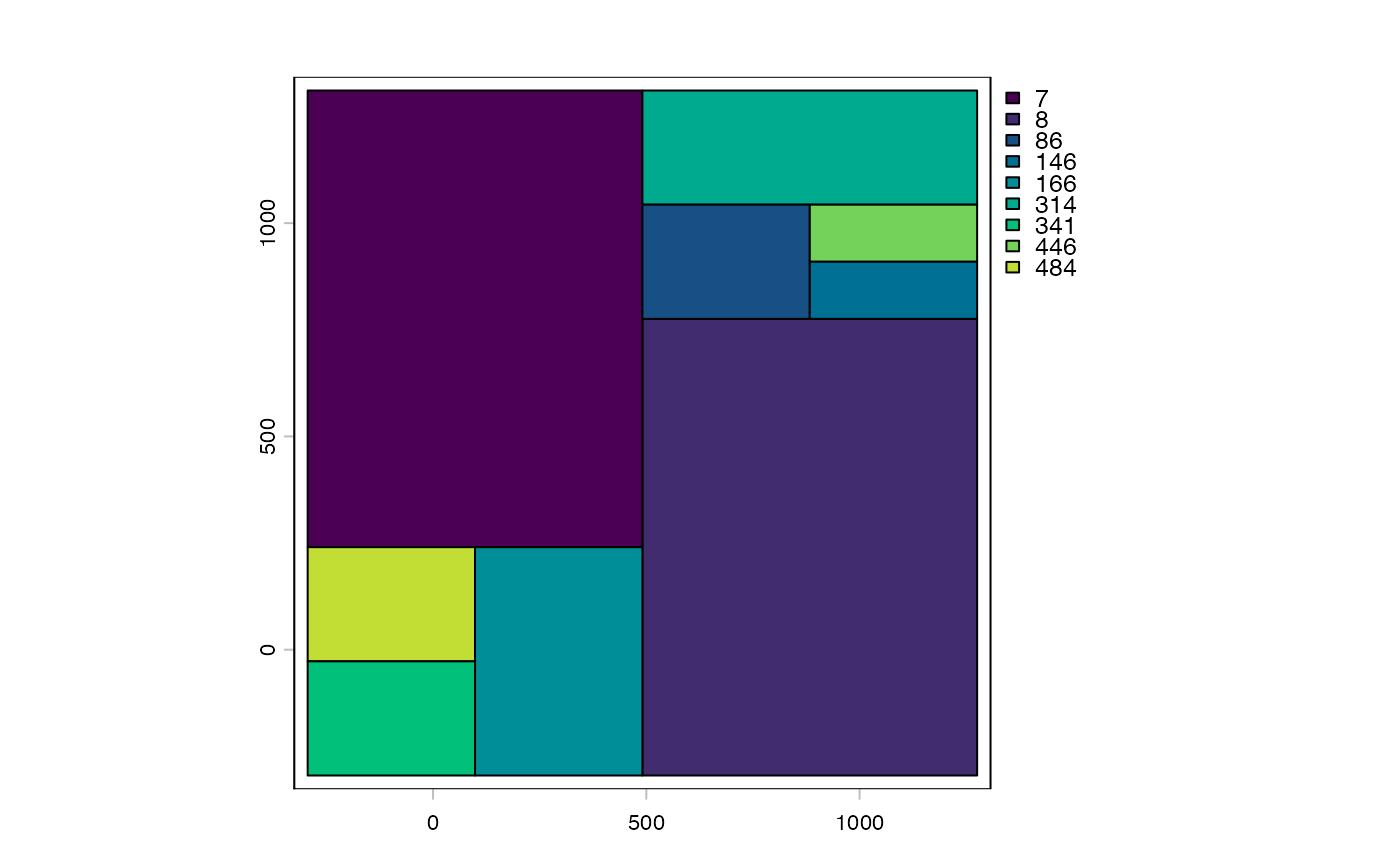
plot(fp, values = "n_records")
# plot with items per tile
plot(fp, values = "n_records")