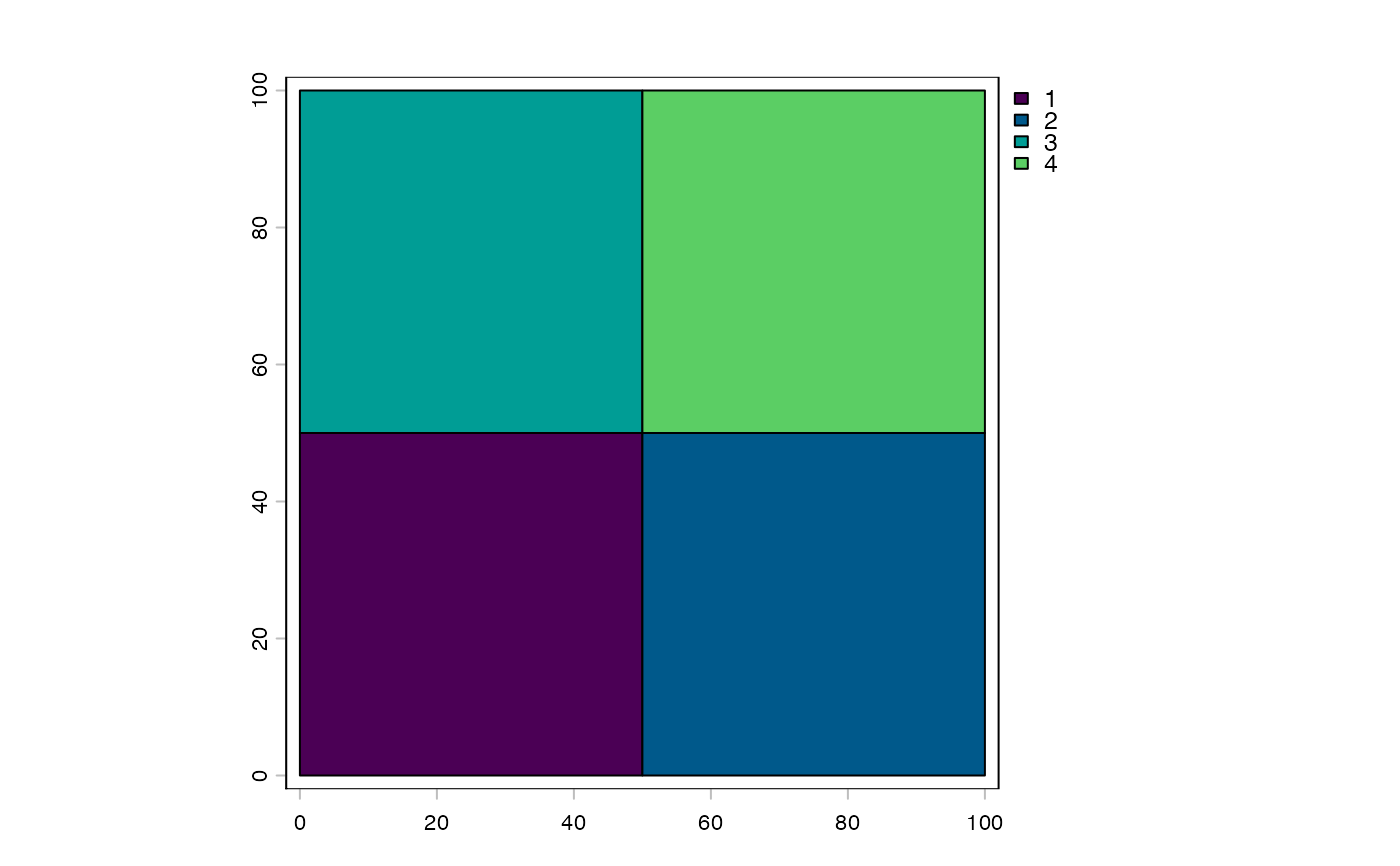
Tile plan defined by explicit per-tile bounds with no required uniformity
in size or spacing. The bounds matrix is the canonical representation —
there is no center-plus-dims formula. Always returns SpatExtent from
[i]. Primary use case is as the output of adaptive spatial decomposition
algorithms such as quadtrees on vector/point data.
Tile plan defined by explicit per-tile bounds with no required uniformity in size or spacing. Unlike grid-based plans, the bounds matrix is the canonical representation — tile positions are not computed from a formula.
The primary use case is adaptive spatial decomposition of vector/point
data, where high-density regions require small tiles and sparse regions
can use large tiles. See quadtreePlan() for the iterative construction
workflow.
Note
@tile_dims is intentionally not populated. Any method that requires
uniform tile dimensions will not work with freeTilePlan.
Setup
freeTilePlan()creates an empty instance.$bounds<-sets the n x 4 bounds matrix (xmin, xmax, ymin, ymax). Setting bounds triggers reinitialization of@n,@dims, and@metadata.$pad/+/-add spatial padding as with other plans.
See also
Other tile plans:
freeTilePlan,
pixelTilePlan-class,
pointTilePlan-class,
quadtreePlan(),
spatialTilePlan-class,
tilePlan,
tilePlan-class,
tilework-class
Other tile plans:
freeTilePlan,
pixelTilePlan-class,
pointTilePlan-class,
quadtreePlan(),
spatialTilePlan-class,
tilePlan,
tilePlan-class,
tilework-class